How Windows 8 Throws Computer Users Under the Bus.

The Metro interface fills the screen with “active” tiles designed to give users quick access to a device’s various applications and functions.

Metro Fails the Big-Screen Test

Despite features that let you organize the tiles, the bigger the screen, the more that Metro turns into a jumbled, confusing mess.

Google pays almost $18.7 million to get domains

Google wants love. But so do six other companies. They are after .love, actually, a new "top-level domain"

Thursday, 27 September 2012

How to Recover Deleted Pictures from a Memory Card

Memory Card Picture Recovery

Everybody has a digital camera these days. More and more people use digital cameras to record wonderful moments. But it seems digital pictures are easier to lose than traditional film pictures because the digital camera has a useful but dangerous delete button or feature. An operation mishap may delete one or all of the pictures instantly. Do you think the valuable pictures were permanently lost? NO! In most cases, there are some easy ways to restore them. 


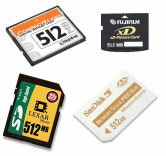
A digital camera stores the pictures you take as separate files on a flash memory card (also known as "digital film"). There are many different types of memory cards such as SD, CF, xD Picture Card, SmartMedia, Memory Stick, the MMC Card and more. In addition, each card type has different brands like SanDisk, Kingston and more. They have different sizes, capacities and appearances, but they are just the same when acting as storage to hold pictures - they are similar to your old floppy disk or hard drive. When you delete one or more pictures from your camera, your camera locates the picture files on the memory card, then "deletes" them and marks the leftover space as usable. In most cases, for fast processing, the camera doesn't delete the picture file body but leaves them as is, which makes it possible for us to retrieve them after deletion.


Okay, let's begin. To recover the deleted pictures, you need to connect your camera to your computer (usually via USB). If your camera does not appear as a drive letter in "My Computer", an external USB card reader is necessary. You may find such card readers from local computer shops, Amazon, BestBuy, or Wal-Mart. They're very cheap and very useful, not only for data recovery, but also for photo retrieval and processes in daily life. When you insert the card in the card reader, and connect the card reader to your computer, it will appear as a drive letter in "My Computer", which will allow a software tool to access the data on the memory card.

If you have your camera or card reader connected, you may download the picture recovery software CardRecovery by clicking this download link.

It's a small download and you may get it in less than one minute. Run the downloaded executable file and follow the instructions to install it on your computer. Then launch it. It has a wizard-style interface and it's very easy to use.

Card Recovery Screenshot

Click "Next" on the welcome window, it will bring you to Step 1. In Step 1, you may specify the drive letter of your camera or card reader, as well as other options including file type to retrieve and destination location to save the recovered pictures. Click "Next" to Step 2 and the scan will start. Depending on the capacity of your card, it may take several minutes for the software to fully scan your memory card. The found pictures during the scanning process will be listed. You may preview the detected pictures as thumbnails in Step 3, and choose the deleted pictures that you want to recover. After that, click "Next" again and CardRecovery will save the selected pictures to the location you specified in Step 1.

Retrieve Deleted Photos

Your deleted pictures are recovered and got back again. It couldn’t be any easier and faster!

Tips:

1. Don't put additional pictures on your memory card if you find you have deleted some pictures by mistake. Otherwise it may cause overwriting and make them unrecoverable.

2. Use an USB 2.0 connection if available to connect your camera or card reader to your computer, it may make the scan much faster than an USB 1.0 connection. 


Tuesday, 25 September 2012

HR checking candidate background on Facebook, Twitter, Google

A majority of employers and recruiters are now using social media sites like Facebook and Twitter, search engines and criminal records to learn the truth about job seekers.

A survey conducted by Australia-based software firm Nuage Software showed over half of human resource managers surveyed ran a Google search on candidates, 74 per cent checked LinkedIn, 23 per cent Facebook and three per cent Twitter.

According to tech firm Nuage's managing director David Wilson, some employers are asking to view Facebook and Twitter profiles at interviews in order to avoid privacy concerns, Perth Now reports.

"The internet has a very long memory. An ill-advised or impulsive post can be rapidly replicated across many sites and be impossible to take back," the report quoted Wilson, as saying

"People really do enjoy the freedom of expression on social media, but it is worth considering the cumulative effect of their postings," he added.

According to the report, Australia's National Crime Check managing director Martin Lazarevic said the variety of employers getting police checks on applicants had grown rapidly in the past six months, and as many as one in ten checks were catching people out. (ANI)


Monday, 24 September 2012

National Policy on IT to create 10 million jobs by 2020

The National Policy on Information Technology 2012, which envisages the growth of the IT market to $300 billion and creation of another 10 million jobs by 2020, has been approved by the union cabinet.

A statement from the communications and  IT  ministry said the policy attempts also to leverage India's global edge in information and communication technology (ICT) to advance national competitiveness in other sectors, particularly those of strategic and economic importance.

The thrust areas of the policy includes encouraging adoption of ICTs in key sectors to improve their competitiveness and productivity besides providing fiscal benefits to small and medium enterprises and start-ups for adoption of IT in value creation.

It envisages creating a pool of 10 million additional skilled manpower in ICT and make at least one individual in every household e-literate.

The policy will enhance transparency, accountability, efficiency, reliability and decentralization in government and in particular, in delivery of public services.

The policy will be notified in the Gazette shortly, the ministry said.


Yahoo to give employees any smartphone they like


Marissa Mayer is giving everyone at Yahoo an iPhone 5, reports Nicholas Carlson:
New Yahoo CEO Marissa Mayer just sent an email to all of Yahoo's full time and part time employees in the US, promising them a new Apple, Samsung, Nokia, or HTC smartphone.
"People are happy," says a source at the company.
But here's a buried lede:
Yahoo is also going to discontinue IT support for Blackberry phones.
The first momentary, blurting sucking noise from the drain around which RIM circles.


Microsoft: The biggest thing about India is the scale


 More than 3,000 developers gathered at the KTPO grounds in Whitefield, Bangalore, on Friday to write applications for Windows 8 as the company bid for entry into the Guinness Book of World Records for the most participants in a single app development event.

"The work involved in getting the venue ready was substantial," said a Microsoft spokesperson. "The ground was uneven - it had to be levelled. Then the infrastructure - we have 63 generator trucks standing by. We had to put in place 4,000 power connections. I think there's around 60,000 feet of cabling that had to be laid. Then there was Internet access to be provided - 2 GB of bandwidth . We have something like 500 people working as crew."

The 18 hour event has to follow certain rules to qualify for inclusion in the Guinness Book. Paul O'Neill , vice president for the Guiness Book of World Records , laid these out in his opening speech. "Participants cannot step out of the premises for more than 60 minutes. They need to have a background in computer science or computer engineering or the sciences. The final number will be the number of developers present at the site at 8:00 am on Saturday."

Steven Sinofsky, the president of Windows and Windows Live at Microsoft, sent a video message wishing the developers luck. For Microsoft, the app fest is a build-up to the launch of Windows 8 on October 26, and a means to create excitement amongst developers to build on that platform.

Indian IT icon and UID evangelist Nandan Nilekani also made an appearance - wishing he was thirty years younger and able to roll up his sleeves and get into the code with the rest of the participants.

Participants from all over India huddled over laptops running Windows 8 RTM (release to manufacturing) and Microsoft's Visual Studio 2012. There were a few Macs as well. Sreeju, a 31 year old city based software professional, came to the event with a Mac. "I had to cover the Mac logo with sticker tape," he grinned. Unfortunately, the tape wasn't opaque enough and his notebook, along with a few others, did attract attention.

A group of R V College of Engineering students said they worked their way through a Windows 8 media centre app. Balachander, a final year computer science student, said, "The new UI does take some getting used to."

Guinness's Paul O'Neill screened random participants for credentials: "We have screened around a 100 participants so far. They have been extremely enthusiastic about the event. We are optimistic that a record will be made today ."

"The biggest thing about India is the scale of things," says Joseph Landes, general manager of developer & platform evangelism at Microsoft India. "Abroad, we get 100-200 developers at these events, here we have thousands participating."

The enthusiasm was borne out by the fact that the first app - a Web Radio app - was completed in less than 6 hours after the event launched.

KTPO grounds in Whitefield, Bangalore, on Friday to write More than 3,000 developers gathered at the KTPO grounds in Whitefield, Bangalore, on Friday to write applications for Windows 8 as the company bid for entry into the Guinness Book of World Records for the most participants in a single app development event.

"The work involved in getting the venue ready was substantial," said a Microsoft spokesperson. "The ground was uneven - it had to be levelled. Then the infrastructure - we have 63 generator trucks standing by. We had to put in place 4,000 power connections. I think there's around 60,000 feet of cabling that had to be laid. Then there was Internet access to be provided - 2 GB of bandwidth . We have something like 500 people working as crew."

The 18 hour event has to follow certain rules to qualify for inclusion in the Guinness Book. Paul O'Neill , vice president for the Guiness Book of World Records , laid these out in his opening speech. "Participants cannot step out of the premises for more than 60 minutes. They need to have a background in computer science or computer engineering or the sciences. The final number will be the number of developers present at the site at 8:00 am on Saturday."

Steven Sinofsky, the president of Windows and Windows Live at Microsoft, sent a video message wishing the developers luck. For Microsoft, the app fest is a build-up to the launch of Windows 8 on October 26, and a means to create excitement amongst developers to build on that platform.

Indian IT icon and UID evangelist Nandan Nilekani also made an appearance - wishing he was thirty years younger and able to roll up his sleeves and get into the code with the rest of the participants.

Participants from all over India huddled over laptops running Windows 8 RTM (release to manufacturing) and Microsoft's Visual Studio 2012. There were a few Macs as well. Sreeju, a 31 year old city based software professional, came to the event with a Mac. "I had to cover the Mac logo with sticker tape," he grinned. Unfortunately, the tape wasn't opaque enough and his notebook, along with a few others, did attract attention.

A group of R V College of Engineering students said they worked their way through a Windows 8 media centre app. Balachander, a final year computer science student, said, "The new UI does take some getting used to."

Guinness's Paul O'Neill screened random participants for credentials: "We have screened around a 100 participants so far. They have been extremely enthusiastic about the event. We are optimistic that a record will be made today ."

"The biggest thing about India is the scale of things," says Joseph Landes, general manager of developer & platform evangelism at Microsoft India. "Abroad, we get 100-200 developers at these events, here we have thousands participating."

The enthusiasm was borne out by the fact that the first app - a Web Radio app - was completed in less than 6 hours after the event launched.


Know why Samsung is waiting for iPhone 5 launch

It is not just the Apple fanboys who are eagerly awaiting the iPhone 5 to launch. Apple's arch rival Samsung too is waiting to get its hands on the iPhone 5 . However, rather than comparing its capabilities with its flagship Galaxy S III, the South Korean manufacturer is waiting to see how many of its patents does the new iPhone violate.


According to Foss Patents, a blog that covers news about wireless patents and mobile devices, Samsung has filed a case management statement with the United States District Court for the Northern District of California against Apple. In the filing, the company said that it is certain Apple iPhone 5 will infringe upon eight of its patents, just like the previous iPhones.

The filing, as per Foss Patents, says, "Samsung anticipates that it will file, in the near future, a motion to amend its infringement contentions to add the iPhone 5 as an accused product. Based on information currently available, Samsung expects that the iPhone 5 will infringe the asserted Samsung patents-in-suit in the same way as the other accused iPhone models. Samsung plans to file a motion to amend its infringement contentions to address the iPhone 5 as soon as it has had a reasonable opportunity to analyze the device. Because Samsung believes the accused functionality of the iPhone 5 will be similar to the accused functionality of other accused Apple products, Samsung does not believe that amendment of its infringement contentions should affect the case schedule."

On Thursday, Samsung said in a separate statement: "Apple continues to take aggressive legal measures that will limit market competition. Under these circumstances, we have little choice but to take the steps necessary to protect our innovations and intellectual property rights."
Apple Korea reiterated its position that it was the victim of copying, not vice versa. "At Apple, we value originality and innovation... We make these products to delight our customers, not for our competitors to flagrantly copy."

This move is part of a larger patent war between Apple and Samsung, where both litigants stressthat the other violates its patents. The biggest development in the battle was last month, when Apple won a lawsuit in the US, its home ground, and Samsung was ordered to pay it over $1 billion in damages. The jury also found that Apple did not infringe any of Samsung's asserted patents.

The iPhone maker then gave a list of 21 Samsung smartphones that it wants banned in the US, including the current flagship Galaxy S III, as well as Galaxy S II, Galaxy Note and Galaxy Ace.

Samsung has appealed against the verdict to the court.

Samsung, the biggest Android phone maker, received a second US legal setback last week when a judge at the International Trade Commission said in a preliminary ruling that Apple did not violate patents owned by Samsung.

Apple's victory was also a blow to Google, whose Android software powers the Samsung products that were found to infringe Apple patents.


Friday, 7 September 2012

Android app to test water quality


When environmental engineer John Feighery got an internship at NASA in the 1990s, he wanted to be an astronaut but he was given a job working with a team designing the US bathroom for the space station.
The small, closet-like space needed a toilet and room for hand washing, bathing and a place to keep toiletries. Feighery also worked on a project to fix equipment designed for monitoring crew health, which included testing water and air quality.
After the Columbia Space Shuttle accident in 2003 left seven crew members dead, the Space Shuttle programme was suspended and further work on the International Space Station was delayed.
Feighery turned his focus from managing water, sanitation and health problems in space to those on Earth.
"I'd been working on supplying clean water to three or four people in space, and meanwhile there are a billion here on earth that don't have it," Feighery said in an interview with AlertNet, the global humanitarian news service. "The world that my kids are going to grow up in has this huge problem that I felt like I could work on."
Work on the ground
After he left the US National Aeronautics and Space Administration Feighery tested well water in Bangladesh for a job funded by the National Institutes of Health, part of the US Health and Human Services department.
He felt the work, which involved using heavy equipment, charting notes and locations by hand and transporting samples in incubators to a distant laboratory could be simpler and less expensive.
That's how he came up with the idea to use inexpensive testing equipment available online, and mWater - an Android app that records the data results of water quality tests and maps them.
The application allows people to track water quality tests at any given water source over time, providing instant results which are put in context with other tests.
The app, which is available in the Google Play Store, also allows users to leave notes for other users about the appearance of the water, its scent, and how the water is flowing from the source, building up an archive of information over time.

A photograph of the water source can be uploaded and location details are registered automatically using a GPS reading from the mobile device.
UN Habitat funded a study in Tanzania to test mWater's capacity to provide local health officers with a simple way to see the quality of water using a mobile phone with an Android operating system.
"It's a very novel approach to water quality monitoring," said Lars Onsager Stordal, who works for UN Habitat's water, sanitation and infrastructure department. "It makes it possible, affordable and manageable at the local level."

Health workers can use the data or even go with a sick patient and easily test the water where they live.
"Anybody can look at it and see what's going on to see if anyone else might get infected," Feighery said. "When fecal contamination occurs somewhere it is the first precursor of disease in water systems. Before cholera spreads there's usually some failure in the sanitation system."
Giving poor people proper access to safe water and sanitation would save 2.5 million people a year from dying from diarrhoea and other diseases spread by a lack of hygiene, according to the charity WaterAid.
Next, Feighery will be working with UN Habitat and Rwanda's ministry of health to help equip health workers to use mWater.


Microsoft announces Windows 8 App Fest in India

Microsoft India has announced the world's largest App Fest for Windows 8, which kicks off on September 21-22, 2012 at the KTPO, Bangalore and is open to the global developer community. This 18-hour-long coding event is a non-stop software jam where developers will design, build, test and submit apps. Microsoft's on-site staff will be available to assist the developers participating in the event with preparing their apps for eventual submission to the Windows Store.

Developers will have the option of submitting Apps in over 20 categories, ranging from food,finance productivity, books, social, photo, music and video and shopping. The Release to Manufacturing (RTM) version of Microsoft Windows 8will be made available to developers attending the App Fest for Windows 8. The participants can bring a team of up to 4 people to build the apps.

Bhaskar Pramanik, chairman, Microsoft India said, "The AppFest will be a memorable and unique opportunity to mingle with Microsoft engineers, programming specialists, trainers, and industry-recognised app developers to drive innovation globally."

Windows 8 provides an opportunity to shape the apps ecosystem around an operating system across multiple devices and hardware formats, giving developers the chance to maximise revenue with little or no tweaking. Windows 8 works seamlessly across multiple coding languages and devices, thereby making it a very flexible base to build on.


Mid-tier IT companies growing faster than biggies

This may come as a surprise. Mid-tier Indian IT firms have been doing as well or better than their top-tier counterparts in recent times. Normally in a downturn, the mid-tier segment tends to be more adversely impacted because customers who are still able to spend on IT prefer the safety of the more established players. But that's not the case now. In fact, the only exception in recent times was the global recession year of 2009-10, when mid-tier firms performed worse than top-tier ones.

Companies like KPIT Cummins, eClerx, MindTree, Persistent Systems, Polaris, Infotech, InfoEdge, Geometric, NIIT Tech, CMC and Zensar had revenue growth rates that were well over 20% in each of the last two years - 2010-11 and 2011-12. Among the best of these were KPIT Cummins, with growth rates of 46% and 38%; eClerx with 37% and 29%; and Zensar with 25% and 46%. In the first quarter of this year, KPIT Cummins' revenue grew 88% to Rs 538.3 crore, Hexaware's grew 37.6% to Rs 438.3 crore and Persistent Systems' grew 34% to Rs 301 crore.

There are several reasons for these blazing performances. Broking firm Edelweiss Securities says a major factor is the repositioning of mid-tier firms as more specialized players since the last downturn. Hexaware and NIIT Tech focused a lot more on the travel and transportation domains, Persistent Systems specialized in outsourced product development, MindTree in manufacturing and KPIT Cummins in automotive.

"This strategy of specialization has enabled mid-tiers not only to get invited to new RFPs (request for proposals) in those verticals but also to participate in newer, complex deals from first-time outsourcers in emerging markets," says Edelweiss.

There's also been a shift in the structure of deals that has benefited mid-size players. Research firm Information Services Group estimates that contracts in the value range of $25 million to $99 million have surged from 481 in 2008 to 770 in 2011, while contracts with a value of more than $100 million have remained stagnant at 224 over the same time.

Sid Pai, partner in Information Services Group, says this fragmentation of deals constitutes a significant opportunity for mid-tier players, and more so given their specialization.

Edelweiss says the sudden increase in deals is being driven by first-time outsourcers who want to test-check the outsourcing model with small-sized deals and with vendors who can give them customized solutions.

Mid-tier players also benefit from the 18% to 30% differential between the prices they charge compared to those of top-tier players. The top players charge a premium for their domain expertise and track record to execute large and complex deals. Edelweiss says in the current uncertain environment, this price difference would play out in favour of mid-tier companies.

Ankita Vashistha, MD of outsourcing advisory firm Tholons, says IT outsourcing is now "mainstreamed", with many more companies adopting outsourcing and technology to cut costs and realize alternative revenue streams in an increasingly competitive and volatile market.

"A large number of mid-tier IT companies are engaging in vertical solutions for large clients and cost optimization for mid-tier clients. We expect mid-tier IT firms to grow in the 22-26% range this year, which is an improvement from a year ago," she says.


Infosys CFO: We are open to bigger acquisitions

Indian IT outsourcer Infosys, which has long said it's comfort size for acquisitions is up to 10 per cent of its own revenue, is open to bigger deals given the right opportunity, a top executive said.

"Whatever size it is, if it makes strategic sense, if we feel we can take it and execute it, we'll look at it," V Balakrishnan, chief financial officer of India's second-biggest software services provider, told Reuters on Tuesday.

"Why not? If it really makes a strategic fit, why not?" Infosys generated revenue of about $7 billion in the fiscal year that ended in March.

Infosys is sometimes chided by investors and analysts for being too cautious with it's $3.7 billion cash pile, even as rivals such as Tata Consultancy Services and Wipro have boosted their businesses with multiple acquisitions.

Infosys wants to accelerate growth in its software business by building other services around those offerings, an area the company calls products and platforms services, which has potential for acquisitions, Balakrishnan said.

Infosys could also look for deals in consulting, where targets are likely to be smaller, he said.

It is also looking to ramp up its business in France and Germany, where it would consider buying local operators, and in the healthcare and life sciences industries, where it is a small player, Balakrishnan said.